Installing the Content Module
Table of Contents
Overview
The AI Security content module is distributed as the ai_security.zip archive, which contains ready-to-use knowledge objects. Install it by using the standard Content Management mechanism.
Module Contents
| Object Type | Objects |
|---|---|
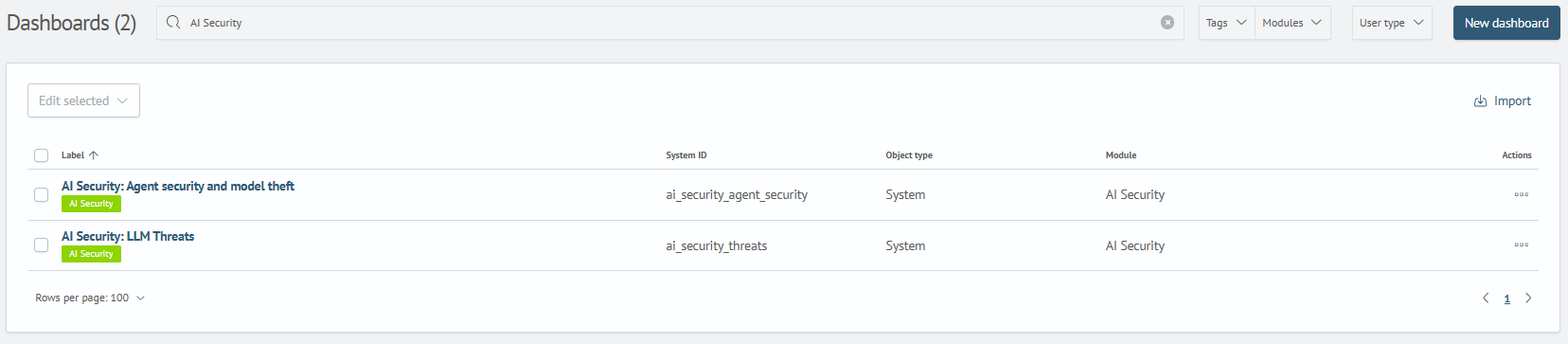
| Dashboards | 2 dashboards covering LLM threats, agent security, and model theft |
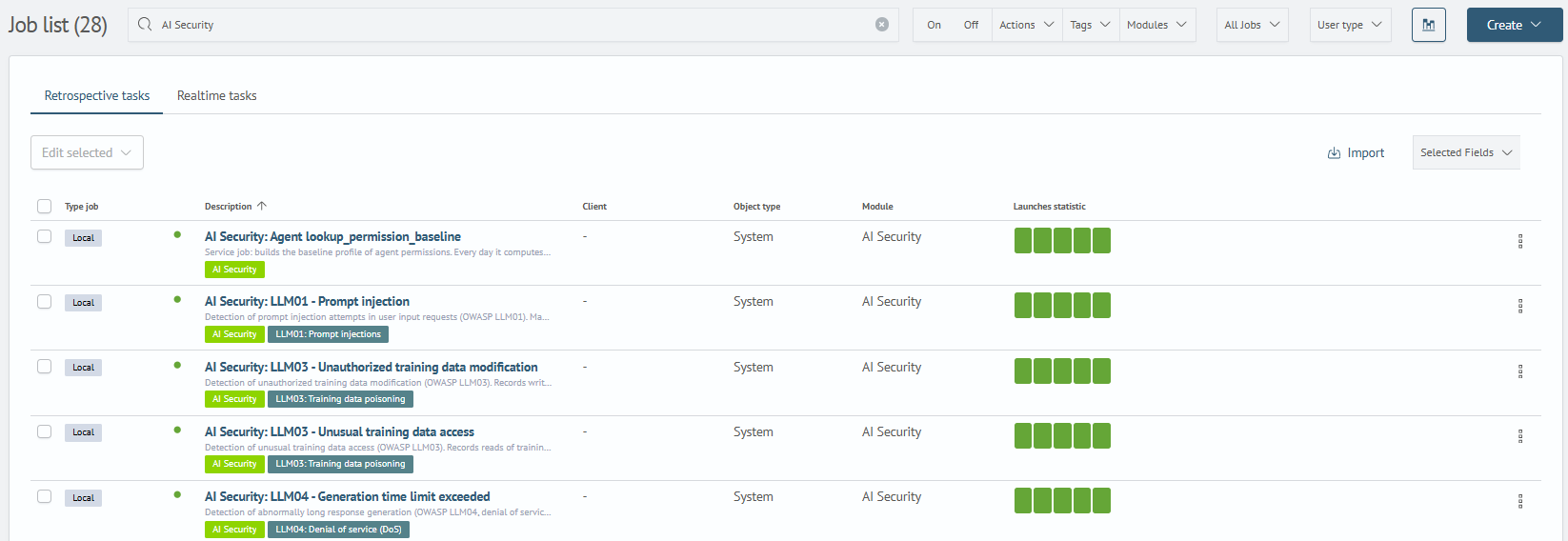
| Scheduled jobs | 26 threat detection jobs grouped by OWASP Top 10 for LLM Applications category and 1 job that populates the agent permission baseline lookup |
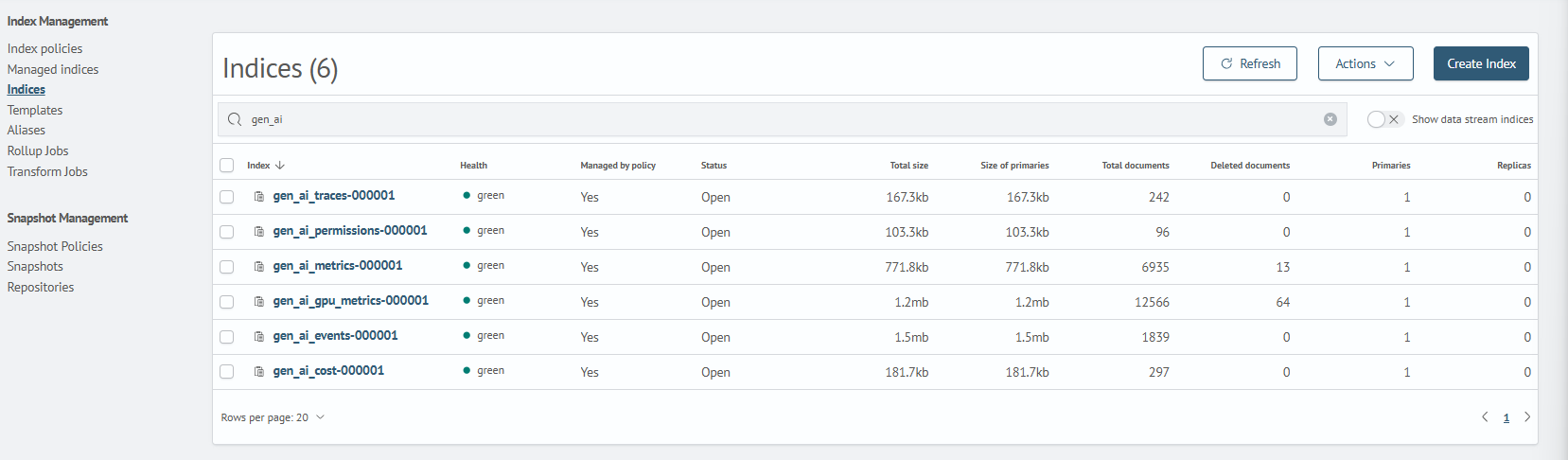
| Runtime indexes | gen_ai_events, gen_ai_gpu_metrics, gen_ai_permissions |
| Tags | AI Security, LLM01, LLM03, LLM04, LLM05, LLM06, LLM07, LLM08, LLM10 |
| ISM policies | Lifecycle policy for gen_ai_* indexes |
The settings in the indexes and policiesism directories must be adapted to the data retention and rotation requirements of the target deployment.
Installation Procedure
Step 1. Install the Module
Follow the instructions in Content Management.
Example
- Go to
Content Management(Main Menu-System Parameters-Module Settings-General-Content Management). - Select or drag the
ai_security.zipcontent module archive. - Confirm the installation. When the process is complete, the objects become available in the corresponding interface sections.
Step 2. Verify the Imported Module Objects
1. Verify the Dashboards
Verify that the two module dashboards are available:
Main Menu - Main - Dashboards
2. Verify the Scheduled Jobs
Verify that the 27 module jobs are available:
Main Menu - Job Scheduler - Jobs List
3. Verify the Indexes
Verify that the indexes are available:
Main Menu - System Parameters - Index Management - Indexes
4. Verify the Index Management Policy
Verify that the ISM policy is available:
Main Menu - System Parameters - Index Management - Index Policies

5. Verify the Tags
Verify that the tags are available:
Main Menu - System Parameters - Module Settings - Tags
- AI Security
- LLM01: Prompt Injection
- LLM03: Training Data Poisoning
- LLM04: Model Denial of Service (DoS)
- LLM05: Supply Chain Vulnerabilities
- LLM06: Sensitive Information Disclosure
- LLM07: Insecure Plugin Design
- LLM08: Excessive Agency
- LLM10: Model Theft